Ink First, Apologize Later: The Unwritten Rules of Drawing Strangers in Public

Photo by Photo by Ruben Valenzuela on Unsplash on Unsplash
There is a moment every urban sketcher knows. You're at a diner in Albuquerque, or gate B14 at O'Hare, or the world's slowest DMV line in a strip mall outside Dayton. And there, three tables over, is the face. The nose like a question mark. The eyebrows permanently mid-argument. The posture of a man who has been waiting for a turkey melt since the Clinton administration.
You have roughly ninety seconds before he leaves, or turns, or notices. What happens next is one of illustration's most quietly practiced arts — and its least officially documented one.
The Golden Rule: Draw Like You're Doing Anything Else
The first lesson of public sketching is posture. Not your posture — your pencil's alibi. The seasoned sketcher has mastered what practitioners privately call the "grocery list stance": head tilted slightly down, eyes flicking up in short, casual glances, the paper angled away like it contains nothing more interesting than a reminder to buy paper towels.
The trick is rhythm. Look, look, draw. Never stare for more than two seconds. A two-second stare is curiosity. A four-second stare is a situation.
Experienced sketchers develop a whole toolkit of cover behaviors. The phone-check feint, where you glance at your subject under the pretense of checking notifications. The "looking past you" gaze, aimed at a point roughly six inches above someone's head. The absolute classic: sketching into the pages of a book, so you appear to be an insufferable person who annotates paperbacks, rather than an insufferable person who draws strangers.
Speed Is Kindness
Here's the ethical wrinkle nobody puts on the workshop flyer: the faster you draw, the less you disturb. A thirty-second gesture sketch takes thirty seconds of someone's attention, tops. A twenty-minute rendered portrait of a woman waiting for her latte means twenty minutes of low-grade surveillance she never consented to.
This is why gesture drawing — loose, quick, capturing the idea of a person rather than their passport likeness — is the backbone of public sketching. You're not making a portrait. You're making a souvenir of a moment. The difference matters, both legally (in some venues) and spiritually (everywhere).
There's also a practical argument for speed: people move. The man hunched over his crossword will not hold that deliciously contorted pose out of courtesy to your composition. He will sit up. He will crack his neck. Your masterpiece of spinal curvature has a shelf life of one sneeze.
The Venues, Ranked by Risk
Not all public sketching locations are created equal, and every illustrator develops a personal risk assessment.
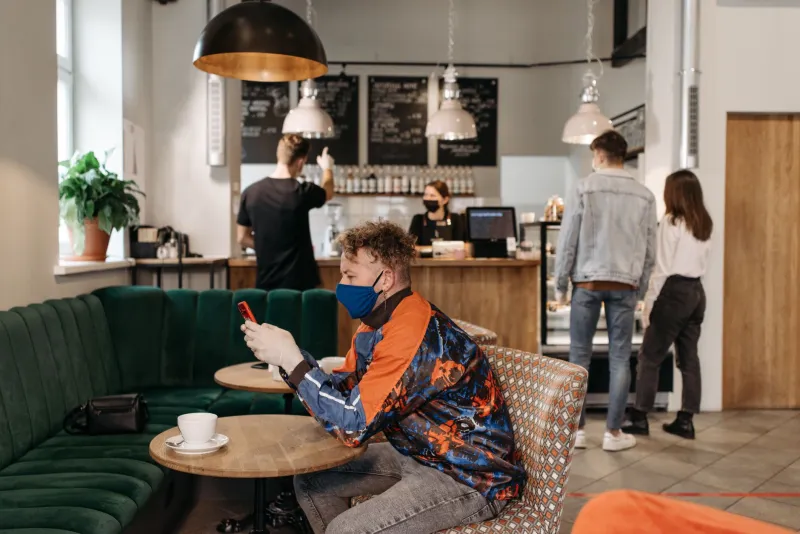
Coffee shops are the classic — a captive, seated, caffeine-docile population. Low risk. People assume you're a student. Lean into it; bring a backpack.
Airports are the Super Bowl of sketching. Everyone is exhausted, unguarded, and wearing their most interesting outfit, because airport outfits are chosen by a different, braver self. Bonus: nobody makes eye contact at an airport. You could sketch a full portrait of the gate agent and they'd never know.
The DMV is a gift. Hours of waiting, faces full of bureaucratic despair, fluorescent lighting that flattens everyone into the same beautiful gray. The only risk is that your subject is also bored enough to notice you noticing them.
Subways are expert-level. Rapid subject turnover, constant motion, and a social contract that says no one looks at anyone. Sketch boldly, but accept that half your drawings will be of people who are now in New Jersey.
The Moment of Discovery
Every public sketcher eventually faces the reckoning: the subject sees the sketchbook.
It usually goes one of two ways. The first is the best-case scenario — genuine delight. "Is that me?" followed by a photo of the page going straight to their family group chat. Strangers are often thrilled to be seen, really seen, by someone with a pencil. In an era where most of us are photographed a hundred times a day without ceremony, a hand-drawn sketch feels like a compliment with actual labor in it.
The second scenario is the wince. The sketch caught them mid-yawn, mid-sneeze, mid-existential-crisis, and now they're looking at the least flattering version of themselves ever committed to paper by a stranger. In these moments, honesty helps: "You had great posture and I got greedy." Most people laugh. A few don't. You let those few keep the page if they want it. Consider it a donation.
Why We Keep Doing It
Ask any illustrator why they risk social awkwardness in a Panera, and the answer is usually the same: people are the hardest and best thing to draw. Faces invented from imagination tend to converge — same jawlines, same symmetrical blandness. Real people come pre-loaded with character. The bus driver with the magnificent mustache did not ask to be drawn, which is exactly why he's better than anything you'd make up.
There's also a quieter argument. Public sketching is a form of attention, and attention is in short supply. To draw a stranger is to say: for four minutes, you were the most interesting thing in the room. Nobody gets that from an algorithm.
So pack the small sketchbook. Sit near the window at the diner. Practice the grocery list stance. And if you ever catch an illustrator mid-glance, pencil hovering, do them a favor — hold the pose for just a second longer. Somebody's sketchbook has a blank spot shaped exactly like you.